
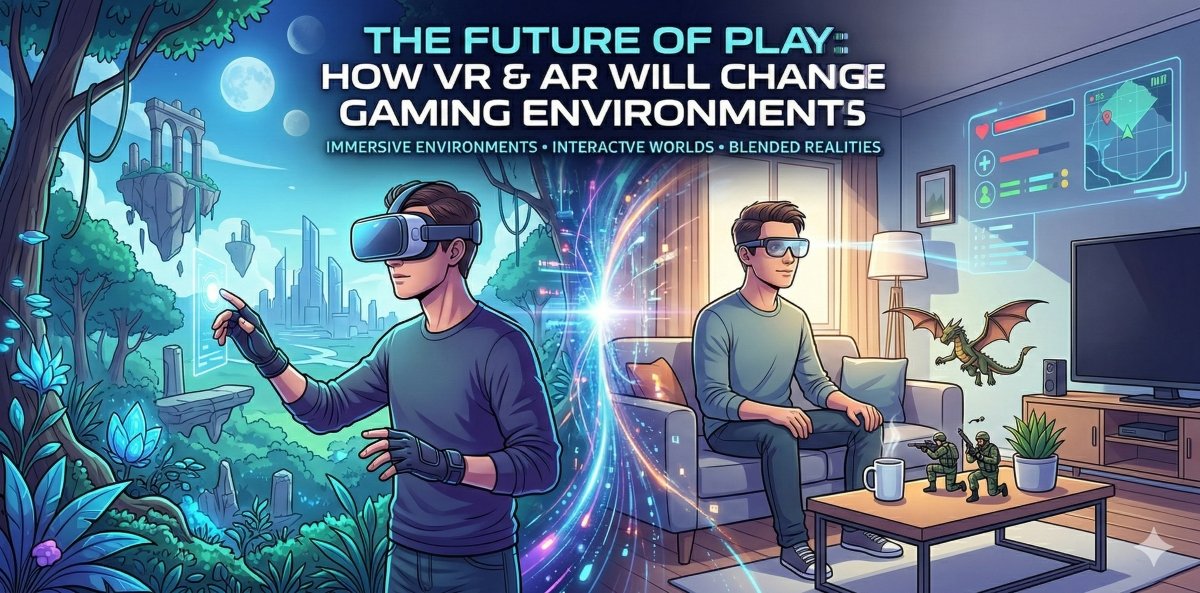
The Future of Play: How VR and AR Will Change Gaming Environments

Do you remember the first video game you ever played? Perhaps you looked at a simple screen and used a joystick to move characters made of basic blocks. Gaming has come a very long way since then. We are now standing on the edge of a new revolution in entertainment. Virtual Reality (VR) and Augmented Reality (AR) are no longer just science fiction dreams. They are real technologies that are changing the way games are designed, played, and experienced. These technologies are not just altering the game characters; they are completely rewriting the rules for gaming environments.
In this article, we will explore exactly how VR and AR will change where and how we play in the near future.
Leaving the Real World: Total Immersion in VR
First, let’s look at Virtual Reality (VR). When you use a VR headset, you cannot see the room you are standing in. You are completely surrounded by a computer‑generated world. This is called “immersion.” In traditional gaming, you look at a screen (a “window”) into the game world. In VR, you are inside that window.
Endless Worlds Without Walls
In the future, gaming environments in VR will have no physical limits. Today, your game might be stopped by the walls of your bedroom. Tomorrow, developers will create environments that perfectly trick your senses. You could be standing on the snowy peak of a fantasy mountain or walking through the crowded streets of a futuristic city. You won’t just be pressing “forward” on a controller; you will be physically walking (in place) and turning your head to see everything. This level of immersion makes the environment feel like a real place, not just a picture on a monitor.
Interacting with Everything
The future of VR environments is also about interaction. Currently, you might only be able to pick up “important” items in a game. In future VR, almost everything in the digital environment will be interactive. You can pick up a rock, open a drawer, or knock over a cup. With advanced haptic gloves (gloves that let you feel digital objects), you might even sense the texture or weight of that rock. This physical interaction connects you to the environment more deeply than ever before.
AR: Bringing Digital Worlds Into Reality
While VR takes you away from reality, Augmented Reality (AR) does the opposite. AR takes digital information—like pictures or data—and puts it “on top” of your real surroundings. Think of the game Pokémon GO, where creatures appear on your phone screen as if they are in your garden. This is the start of AR.
Your Living Room as a Battlefield
Future AR gaming environments will not require you to leave your house. Instead, they will turn your home into the game. Imagine wearing lightweight AR glasses. Suddenly, tiny alien spaceships appear in your living room. They are not just flying around randomly; they are using your real ceiling fan for cover or hiding behind your actual sofa. Your dining table could become a virtual landscape for a strategy game, with miniature soldiers fighting among your salt and pepper shakers. The game learns your physical environment and uses it to enhance the play.
Beyond the Screen: Dynamic Information
AR also changes how you receive information within the environment. Currently, a video game might display your “health bar” or a map in the corner of your screen. This can be distracting. In an AR environment, this information can be placed naturally within the world. If you are playing a racing game in AR, your speed and position might appear as a faint projection on your actual wall. If you are solving a puzzle, clues might be overlayed directly onto the objects you are holding. This seamless integration makes gameplay more intuitive and less cluttered.
Changing How We Socialize
One of the biggest impacts of VR and AR on gaming environments is social interaction. Currently, when you play online with friends, you might see their avatar on your screen, and you talk to them through a microphone. It feels like you are separated by technology. In future VR gaming environments, playing with friends will feel like hanging out in real life. You will be able to see their hand gestures, watch their body language, and look them in the eye. You are not just playing a game together; you are sharing a space together.
This future is becoming possible because the technology is improving quickly. VR headsets are becoming lighter, faster, and wireless. AR glasses are getting smaller and looking more like normal spectacles. High‑speed internet (like 5G) allows huge amounts of environmental data to be streamed instantly, making multiplayer VR and AR experiences smooth and realistic.
Making Games Easier to Learn
Importantly, these technologies make gaming easier to understand, especially for non‑native English speakers or new players. Instead of reading complex menus or memorizing button combinations (like pressing ‘X’ to open a door), you simply reach out and turn the door handle in VR. The interaction with the gaming environment becomes intuitive and natural. This lowers the barrier to entry and makes gaming more accessible to a wider audience.
Conclusion: The Future of Play
The future of play is incredibly exciting. We are moving away from sitting in a chair and staring at a flickering screen. Whether we are fully entering a new universe through a VR headset or watching fantasy creatures climb over our furniture with AR glasses, the environments where we play are about to get bigger, more realistic, and much more interactive.
The traditional “video game” is evolving into a completely new type of experience—one that you don’t just watch, but one that you actually live in. Get ready, because the way we see gaming is about to change forever.